

January 20, 2026 | The Audible
The Math We Avoid Because Its Uncomfortable
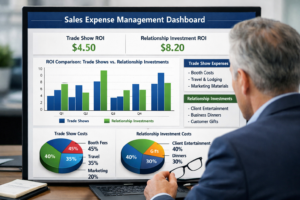
Give me $100,000 in relationship-driven sales expense management, and I’ll outperform your entire trade show strategy.
Tell me I’m wrong.
At first glance, that statement sounds bold. Maybe even uncomfortable. However, before scrolling past, it’s worth walking through the math most sales teams avoid and the mindset problem hidden inside what we label as expense decisions.
In B2B sales expense management, companies often optimize spending to look disciplined on a spreadsheet. Unfortunately, that same discipline frequently comes at the expense of revenue velocity, deal progression, and real customer acquisition ROI. For a deeper dive into building effective sales systems, explore our fractional CRO services.
Why Trade Shows Feel Like the Safe Choice
Walk into almost any executive budget meeting and propose a $50,000 trade show investment. Typically, you’ll get nods, a few surface-level questions, and approval by the end of the week.
After all, the line items are familiar: booths, swag, travel, hotels, staff time, badge scanners, and lead retrieval systems. Because these expenses are well understood, they’re easy to defend. Just as importantly, the optics are clean.
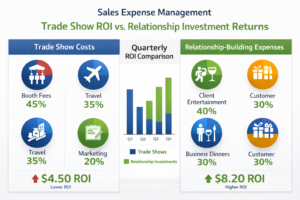
To be clear, trade shows do work. They are genuinely effective for brand awareness, early pipeline creation, and establishing market presence. According to the Center for Exhibition Industry Research (CEIR), face-to-face events remain a cornerstone of B2B marketing. This is not an argument against them.
However, within sales expense management discussions, there’s a question most organizations never pause to ask:
What are trade shows actually optimized for?
Primarily, the answer is scale. They are designed to start conversations in volume and feed the top of the funnel with raw inputs. Over time, sales teams then qualify, nurture, and often disqualify most of those names.
What trade shows are rarely optimized for, however, is the stage of the funnel that actually produces revenue: advancing late-stage opportunities and closing deals.
The Trade Show ROI Math Nobody Wants to Run
To understand the issue more clearly, let’s get specific. Industry benchmarks from organizations such as CEIR and Forrester Research routinely show trade show cost-per-lead ranging from $100 to $800, depending on the event and industry.
For example, imagine a $25,000 investment in a regional trade show that produces 200 leads. On paper, that’s $125 per lead, which appears reasonable by industry standards.
Now apply funnel reality.
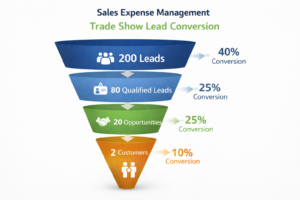
Typically, only about 10% of those leads turn into genuine sales conversations. That leaves 20 real opportunities. From there, roughly 10% convert into customers, especially when the leads haven’t been deeply qualified or nurtured elsewhere.
The result? Two customers from a $25,000 investment.
That puts your cost per acquired customer at $12,500. Moreover, this figure excludes the sales team’s follow-up time, the opportunity cost of chasing dead-end leads, and the months of pipeline management required to reach those two signatures.
Importantly, this doesn’t make trade shows a bad investment. Instead, it clarifies what they actually are: an early-stage pipeline investment with diffuse, delayed, and difficult-to-attribute returns.
The real problem emerges when top-of-funnel spend is treated as the only legitimate way to deploy revenue-generating dollars.
A Sales Expense Management Comparison Most Teams Never Make
Now consider a different scenario. The same dollars, but deployed differently.
Take that same $12,500, the effective cost of acquiring a single customer through a trade show funnel, and place it under the control of a proven sales professional. This time, however, tie the spend to clear accountability and a defined book of active opportunities. This approach aligns with our MSP OS methodology for systematic revenue growth.
What could that budget fund instead?
For instance, it might support eight to ten strategic dinners with decision-makers who are already engaged in the sales process. Unlike badge scans, these are buyers who know your company, have reviewed your proposal, and are actively weighing options.
Additionally, the budget could enable multiple high-intent touchpoints during competitive deals. This is the kind of face time that builds trust precisely when a prospect is deciding between you and two comparable vendors.
Most importantly, these experiences are not entertainment for its own sake. Rather, they are intentional investments in the human dynamics that shorten decision cycles and resolve uncertainty.
At that point, the real question becomes unavoidable: what happens if even one of those interactions changes an outcome?
How Relationship Investment Changes Deal Economics
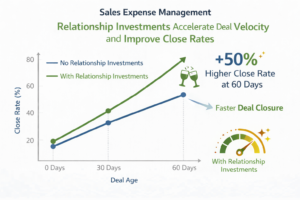
If a single dinner accelerates a deal by 30 days, the impact goes beyond goodwill. Faster revenue recognition reduces sales cycle cost and improves cash flow.
Likewise, if one experience tips a competitive decision in your favor, the value isn’t incremental. Its binary. You either win the deal or you don’t.
Meanwhile, if a relationship investment expands deal size by 15% or removes the need for discounting, the ROI calculation shifts dramatically.
Trade shows generate leads at scale. In contrast, relationship-driven sales expense management moves specific, named, high-value deals across the finish line.
Both approaches have merit. Yet only one is consistently treated as a normal cost of doing business.
The Real Objection Behind Relationship Spend
So why don’t more companies lean into relationship-driven expense budgets?
Contrary to popular belief, it’s not about money. Organizations routinely approve six-figure sponsorships, logo placements, and conference booths with minimal scrutiny.
It’s also not about ROI. As demonstrated, relationship investment can outperform top-of-funnel spend when deployed intentionally.
Instead, the resistance usually comes down to optics and accountability.
Trade shows are easy to track. Badges get scanned. Leads get counted. Reports look tidy in board decks, even if revenue impact remains murky. Research from Harvard Business Review consistently shows that relationship-based selling drives higher customer lifetime value.
By comparison, relationship investments are harder to systematize. A dinner doesn’t produce a lead score. A round of golf doesn’t populate a dashboard. Even so, the outcomes are real. They’re just embedded in the complex human process of how deals actually close.
As a result, companies default to what’s measurable rather than what’s effective.
The Trust Contradiction in Sales Expense Management
Here’s where the logic breaks down.
Companies already trust salespeople with pipeline forecasts that influence hiring plans and board-level decisions. They also grant pricing discretion that directly affects margin. In addition, they entrust reps with customer relationships and sensitive strategic information.
Yet a $500 dinner tied to a named opportunity often requires extra approvals and scrutiny.
That contradiction is hard to justify.
If you trust a rep with a million-dollar forecast, why not trust them with a modest budget to help close the deal that makes the forecast real?
This isn’t a control issue. It’s a mindset issue. Learn more about building trust-based sales cultures through our Channel OS program.
What Accountability Should Actually Look Like
None of this argues against accountability. In fact, it argues for more of it, just applied correctly.
Effective relationship-driven sales expense management should include:
Tying spend to named opportunities, not vague business development categories
Inspecting impact instead of receipts, focusing on deal movement rather than paperwork
Setting clear expectations upfront, with guardrails that define responsible behavior
Reviewing outcomes quarterly, comparing close rates, deal size, and cycle time
Ultimately, accountability isn’t about avoiding trust. Instead, it’s about creating structure that makes trust productive.
Matching Sales Spend to Funnel Stage
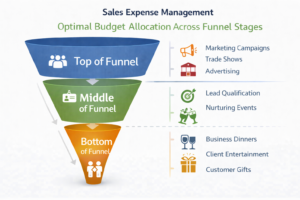
At its core, the insight is simple: different funnel stages require different investments.
Top-of-funnel efforts benefit from scale, including trade shows, content, and advertising. Middle-of-funnel activity thrives on education and engagement. Bottom-of-funnel progress, however, depends on relationship depth.
Most companies over-invest at the top and under-invest at the bottom. Consequently, pipelines bloat, deals stall, and forecasts slip.
Logos build awareness. Relationships build confidence. Confidence closes deals.
The $100K Sales Expense Management Experiment
So here’s the challenge.
Give a proven sales professional $100,000 in relationship investment budget. Tie it to a defined book of business. Set accountability metrics. Review results quarterly.
Then compare those outcomes to $100,000 in trade show spend over the same period.
Trade shows are easy to approve because they’re easy to explain. Relationship budgets require trust. However, that harder conversation may be the most important one your organization isn’t having.
Ready to Transform Your Sales Expense Strategy?
If you’re ready to rethink your sales expense management approach and drive real revenue results, schedule a consultation with The Audible. We help B2B sales teams build systems that close deals, not just generate leads.
About the Author
George Fisher is the Founder of The Audible, providing fractional CRO services to growth-stage companies, and Co-Owner of Blue Pill Cyber, a veteran-owned cybersecurity MSSP. With over 20 years in sales leadership including VP roles at Logically/Cerdant and Branch Sales Manager at Xerox, George focuses on building sales systems that prioritize relationships over activity metrics. A Navy veteran who served as an Electronic Warfare Technician during Desert Storm, he works with MSPs, defense contractors, and growth-oriented B2B companies across Central Ohio and beyond.
Connect with George on LinkedIn or reach out to discuss how relationship-driven selling might fit your revenue strategy.