
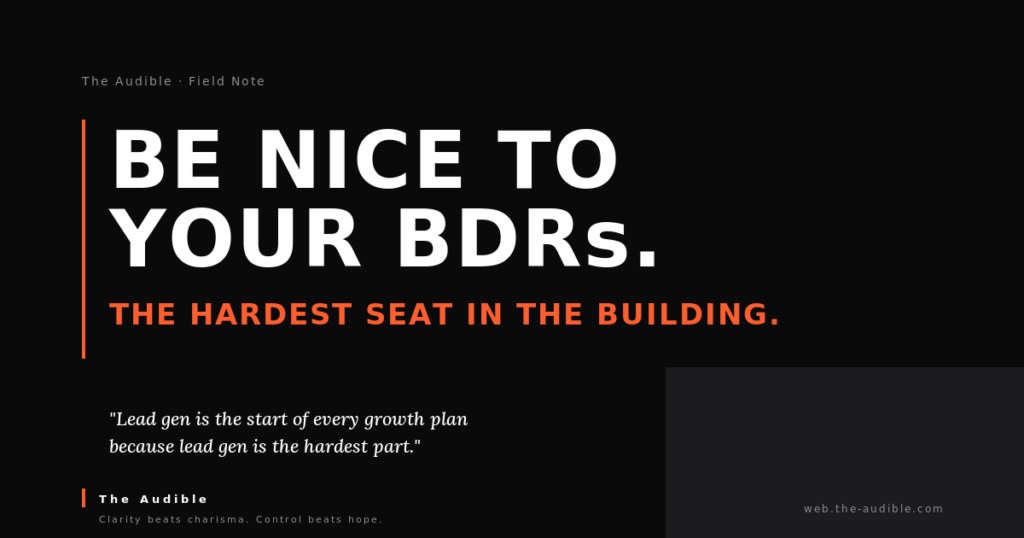
They are doing the job no one else in your building is willing to do. Treat them accordingly.
Every growth plan starts the same way. A whiteboard. A revenue target. An arrow pointing up and to the right. And somewhere near the bottom of that arrow, usually in the smallest box on the slide, sits the word pipeline.
Then someone says it: “We just need more top of funnel.”
And the room nods. Because everyone in the room agrees pipeline is the answer. Everyone in the room also agrees that someone else should go get it.
That someone is your BDR. Your SDR. Your appointment setter. The 24-year-old on your team who shows up every morning, opens a dialer, and absorbs eight hours of human friction so the rest of your sales org can have warm conversations.
And we, as an industry, treat them terribly.
The Job Nobody Wants
Lead generation is the most universally praised and least universally practiced skill in B2B. Every CRO claims it is the foundation of growth. Every founder writes about it on LinkedIn. Every consultant builds a deck around it.
Almost none of them will sit in the chair and do the work.
Sitting in the chair means:
- Getting hung up on. Forty times before lunch.
- Being told to remove yourself from a list, by someone who opted into the list.
- Hearing “I’m in a meeting” from a person who is clearly not in a meeting.
- Sending forty-eight emails to get three replies, two of which are angry.
- Walking into a Monday standup to hear an AE say the lead you booked “wasn’t a fit,” without ever telling you why.
The people who do this work, well, are extraordinary. The people who do it well and stay upbeat are unicorns. And most companies treat both like they are interchangeable temps.
What Actually Happens to Your BDRs
Three forms of friction land on the BDR seat every day. None of them are theirs to solve.
Customer friction. Buyers vent at BDRs about budget freezes, vendor fatigue, and the seventeen other reps who called this week. The BDR did not cause any of that. The BDR catches it anyway.
Coworker friction. AEs complain when the lead is not perfect. Marketing complains when the lead is “too cold.” Ops complains when the disposition codes do not match the dashboard. Everyone gets a vote. The BDR gets the blame.
Leadership friction. Activity targets that do not reflect reality. Quota math that assumes a connect rate the data does not support. Comp plans that punish quality and reward volume, and then a quarterly review that punishes volume and rewards quality.
A good BDR holds all three of these tensions at once and still books the meeting. That is not a job. That is a discipline.
The Quiet Cost
When you treat your BDRs like a renewable resource, here is what you lose:
You lose the institutional knowledge of every account they have worked. They take that to the next employer.
You lose the qualification instinct they built over six hundred calls. The next person takes nine months to rebuild it.
You lose your culture, slowly, because the people watching how you treat the bottom of the org chart are deciding whether they want to climb it.
And you lose pipeline. Not because the new BDRs are worse, but because the new BDRs are new. And new BDRs do not book meetings at the same rate as the ones you just burned out.
What To Do Instead
There is no framework here. This is not a methodology. It is four sentences.
Tell them they matter. Out loud. By name. In front of other people. “We are lucky to have you running this seat” is a complete sentence and it costs nothing.
Defend them in the room they are not in. When the AE complains about a lead, ask what they did with it before you ask the BDR what they did to source it. The order matters.
Give them a real feedback loop. Not a dashboard. A conversation. What converted, what did not, what the buyer actually said. BDRs do not need more reports. They need closure on the calls they made.
Pay them like the role pays back. A BDR seat with a clear path to AE, a comp plan that rewards qualified opportunities, and a manager who actually coaches will outperform a comp plan with a higher OTE and none of the rest.
The Reframe
Lead gen is the start of every growth plan because lead gen is the hardest part. Not the most strategic. Not the most senior. The hardest. The part with the most rejection per hour, the smallest margin for error, and the least credit when it works.
The people who do it deserve to be hugged up, not kicked down.
Your AEs can be replaced in a quarter. Your BDRs, the good ones, take a year to rebuild and they remember exactly how you treated them on the way out.
So pick a name. Walk over. Or send a message. And say the thing.
We are lucky to have you doing this. Thank you for sitting in the hardest seat in the building.
It will land harder than any spiff you have ever run.
The Audible installs disciplined channel sales motions for MSPs, consultancies, and platforms. We have sat in every seat, including the hardest one. the-audible.com